
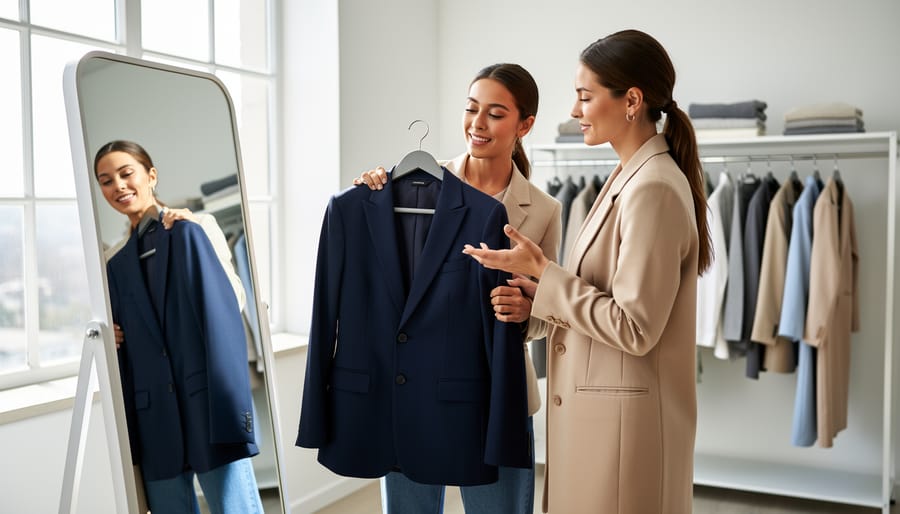
The client empowerment model is a styling approach where the stylist’s job is to help you make confident choices for yourself, rather than handing you a finished look to copy. You bring your body, your lifestyle, your history with clothes, and your own sense of what feels like you. The stylist brings expertise, honest guidance, and the tools to turn all of that into outfits you actually want to wear.
It works best under specific conditions, and that’s what this article covers. The model is effective when your preferences lead the conversation, when advice is built around your real life instead of a trend report, and when you walk away understanding why something works, not just that it does. A navy blazer might be a wardrobe staple on paper, but if you never reach for it, it isn’t doing its job.
Below, you’ll find a plain-language breakdown of how the model works, its core components, and where it shows up in practice. Most importantly, you’ll see the signs that it’s genuinely working for you, so you can recognize empowering styling when you find it. Individuality isn’t a bonus here. It’s the whole point.
What the Client Empowerment Model Means in Plain Language
At its simplest, the client empowerment model rests on one idea: you are the expert on your own life. You know what you do all day, what feels comfortable on your body, and what makes you light up in the mirror. A stylist brings the other half, which is knowledge of fit, fabric, proportion, and what’s out there, plus honest guidance when you ask for it.
Many stylists work the other way around, where the expert decides and the client goes along. That approach can be quick, and some people enjoy handing over the reins. But if you’ve ever stood in a fitting room holding something that was clearly chosen for someone else, you know the gap it can leave. In the empowerment model, your style story leads the way, not a list of this season’s trends. That’s what Client Empowerment through Individuality means in practice, and it’s how you learn to own your style instead of borrowing someone else’s.
A few terms come up again and again, so here’s a quick glossary in everyday language:
- Client empowerment
- Giving you the information, options, and confidence to make the final call on what you wear.
- Individuality
- The mix of taste, history, body, and personality that makes your look yours alone.
- Personalized consultation
- A styling conversation built around your life and occasion, not a one-size-fits-all formula.
- Collaborative styling
- You and your stylist working side by side, trading ideas until something feels right.
- Authentic style
- Clothing that matches who you really are, so you feel like yourself the moment you put it on.
Put together, these terms describe a partnership where nobody has to pretend to be someone else.
How a Client-Led Dress Consultation Works
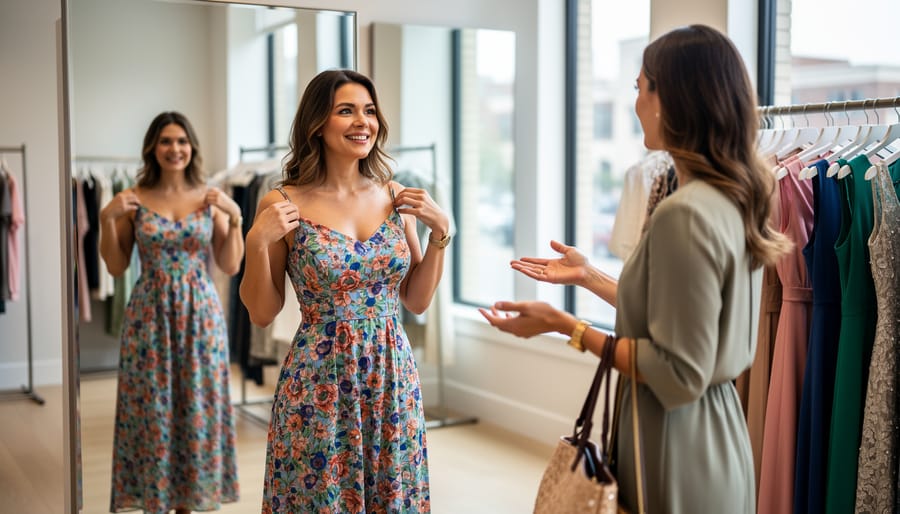
Starting With Your Story, Not a Size or a Trend
A good consultation starts with you, not with a tape measure or a trend report. Before anyone pulls a single dress off the rack, your stylist should be curious about the life you’re dressing for.
Expect questions like these: What’s the occasion, and who will be there? What’s the one thing you’ve worn that made you feel completely like yourself? What do you reach for on a busy morning, and what stays in the back of the closet? How do you want to feel when you walk into the room?
Those answers do real work. They tell a stylist far more than a size tag ever could, and they keep the conversation from sliding into assumptions about what “suits” a certain body type or age. Nobody should decide, before you’ve said a word, that you ought to hide your arms or stick to muted colors because of a birthday. Your story sets the direction.
That’s what Client Empowerment through Individuality looks like in practice. If you adore bold prints, a good stylist wants to know why. If you’re nervous about a neckline, she’ll ask what’s behind it instead of simply steering you away. Come ready to share your preferences, worries, and favorites, because the more you say, the more the finished look will feel like yours.
Where the Stylist’s Expertise Fits In
Empowerment doesn’t mean your stylist goes quiet. Think of her as a well-informed guide who knows the terrain, while you choose the destination.
Her expertise shows up in the details that are hard to judge on your own. She can tell you why a structured crepe holds a silhouette better than a slinky jersey, or how moving a waistline up an inch can change the whole line of a dress. She’ll talk through proportion, how a neckline frames your shoulders, and whether a fabric will still feel comfortable after four hours of dancing. She also keeps the occasion in view, from a daytime garden ceremony to a candlelit gala.
What makes this empowering is how she shares it. Instead of announcing “this is the one,” she offers options and explains her reasoning, so you understand the why behind each suggestion. You might hear, “This cut gives you room to move, and here’s what that means for the photos.”
Then the decision comes back to you. If you love a dress she hesitated over, she can help you make it work. Her job is to sharpen your choices, never to replace your voice.
The Core Elements That Make the Model Work

Think of the client empowerment model as a small set of habits that work together. When one is missing, the whole experience feels a little off, like a dress with one button done up wrong. Here’s what makes it hold together:
- A stylist who listens first, before a single hanger comes off the rack.
- Curated options instead of overwhelming racks, so choosing feels exciting rather than exhausting.
- Plain-spoken, kind advice about fit, fabric, and proportion.
- Real space to say “not for me” without apology or awkwardness.
- Genuine celebration of what makes you distinct, not just what’s on trend.
Each of these does its own quiet work. Active listening is what turns your story into a shortlist that actually reflects you. When a stylist hears that you want to feel graceful but still able to dance at your cousin’s wedding, the options that appear are already closer to right.
Real choice is what makes the final look feel like yours. A curated handful of dresses gives you enough to compare without the fog of too many options, and the decision stays in your hands. That sense of ownership is a big part of why you walk out feeling confident rather than just dressed.
Honest, kind guidance is where the stylist’s expertise earns its place. Hearing “this cut pulls at the shoulders, but this one moves with you” helps you choose with clear eyes, and good guidance is always offered with reasons, never as a verdict.
Respect for individuality ties it all together. It means your taste, comfort, and body are treated as the starting point, not a problem to solve. When that respect runs through every step, satisfaction with the finished look tends to follow, because the outfit reflects you instead of a template.
When the Client Empowerment Model Is Effective
When You Feel Safe Being Honest
The model only works if you can actually tell the truth in the room. That means saying “I love this color but I’d never wear it near my arms,” or “I’m not sure what I want yet,” without bracing for a raised eyebrow.
When a stylist creates that kind of space, the details that matter start to surface. You might admit you hate how a neckline sits, or that a certain silhouette reminds you of something you wore years ago and never felt right in. None of that is picky. It’s information, and it’s exactly what makes a recommendation personal instead of generic.
A safe space sounds like curiosity, not correction. Your stylist talks about bodies in terms of what you want to highlight, balance, or simply enjoy, never as problems to fix. Words like “flattering” get replaced by questions like “how do you want to feel in this?”
If you’re unsure about something, that counts as an honest answer too. Uncertainty is a perfectly good place to begin exploring.
When the Occasion and Your Priorities Are Clear
Choice only feels empowering when you have a way to sort through it. A rack of two hundred dresses can leave you more stuck than when you walked in. That’s why a good stylist asks about the basics early: what’s the event, where is it, and how much time do we have?
A garden ceremony in July calls for different fabrics than an evening reception in November. Once you share the setting and your timeline, the options narrow to a handful you can actually picture yourself wearing. If you’re unsure what an invitation means by “cocktail” or “formal,” some dress code guidance can help you decode it before you shop.
Then add your own must-haves. Maybe you need pockets, sleeves, or a dress you can dance in. Naming those priorities means every choice you make is yours, and it’s easier to say a confident yes.
When Guidance and Choice Stay in Balance
Empowerment doesn’t mean your stylist goes quiet. The sweet spot is a back-and-forth where expert input informs your choices without replacing them. Research on collaborative settings suggests shared decision-making improves outcomes and that holds true at the rack, too.
Picture a stylist suggesting a different neckline than the one you reached for. She explains why: it balances your shoulders, or it photographs beautifully at an outdoor ceremony. You listen, try it on, and decide. Maybe you love it. Maybe you keep your original pick, and that’s perfectly fine.
What matters is staying curious. A fresh perspective is a gift you can accept or set aside, and the final call is always yours.
How the Model Shows Up Across Fashion, Beauty, and Weddings

The client empowerment model isn’t tied to one kind of appointment. It travels. Whether you’re pulling together a casual weekend outfit or planning a full wedding party, the same principle leads: your individuality sets the direction, and the stylist’s expertise helps you get there.
Here’s what that looks like in real life:
- Finding an evening event dress that feels dressy without feeling like a costume.
- Choosing a wedding guest or bridal party look that suits your taste and the setting.
- Planning a custom piece built around the details you’ve always wanted.
- Refreshing a wardrobe for a new chapter, like a new job, a move, or a milestone birthday.
- Matching a look with hair and makeup choices so everything feels like one story.
In everyday and evening wear, the conversation usually centres on comfort, versatility, and how you want to feel walking into the room. A stylist might suggest a few silhouettes and explain why a certain neckline or fabric could work, but you decide what feels like you.
With custom looks, the model really shines. You bring the inspiration, the stylist brings the know-how on construction, fit, and fabric, and together you shape something nobody else will have.
Bridal and wedding party dressing adds more voices to the room, which makes the model even more useful. A bride might love a simple, elegant gown, and the stylist can help her think through the finishing touches so she can accessorize your look in a way that reflects her personality, not just a trend. Bridesmaids and mothers of the bride get the same respect, each choosing within a shared palette or theme without losing herself in it.
Beauty fits in naturally too. Hair and makeup choices are another place where your preferences lead, with an expert offering options that complement your outfit rather than overriding your taste.
The details change from one setting to the next. The heart of it doesn’t: you’re the authority on you.
Common Questions About Empowering Style Consultations
Starting a styling conversation can bring up a few worries, and nearly everyone has them. Here are the questions that come up most.
What if I don’t know my style yet?
That’s completely okay, and it’s a great place to start. A good consultation helps you discover your style by asking about the clothes you reach for, the moments you’ve felt your best, and how you want to feel.
Will a stylist just tell me what to wear?
Not in a client-led approach. Your stylist offers options and explains her reasoning on fit, fabric, and proportion, but the final decision is always yours.
What if I change my mind during the process?
Changing your mind is part of exploring, not a sign that you’re difficult. Open feedback is exactly what helps a stylist get closer to what feels right for you.
How do I prepare for my first consultation?
Bring a few photos you love, a sense of the occasion and timeline, and any must-haves or no-gos. Even a short list of how you want to feel is plenty to get started.
You might also wonder whether you’re being “too picky.” You aren’t. Knowing what feels comfortable, and what doesn’t, is useful information, and it helps your stylist narrow the field faster. The same goes for concerns about age or body shape. If you’re curious about silhouettes and details that feel flattering over 40 for example, the conversation should open up possibilities rather than close them down.
As for the worry that a stylist will push her own taste, a good one will notice when she’s drifting from your story and steer back. If you ever feel unheard, say so. A supportive stylist will welcome it, and the whole process works better because of it.
So here’s the heart of it: the client empowerment model works when you’re treated as the authority on your own individuality, and your stylist brings the expertise to help you act on it. Your story steers. Their guidance sharpens the options, explains the why, and keeps things honest and kind.
When that balance is there, the process stops feeling like a test you could fail. You speak freely, you hear fresh ideas without pressure, and the final choice is yours. That’s where real confidence comes from.
So at your next styling conversation, bring your whole story: the pieces you love, the things that make you wince, the occasion, and the way you want to feel. Expect to be heard. And expect to walk out feeling confident and uniquely, wonderfully yourself.